Introduction
Dealing with a kitchen sink that refuses to drain or a garbage disposal that hums angrily instead of grinding can instantly bring your daily routine to a grinding halt. When you are navigating a kitchen remodel or replacing a unit that has given out after years of faithful service, finding reliable garbage disposal installation Detroit services becomes an urgent priority. Homeowners across the Motor City—from historic neighborhoods in Boston-Edison to modern builds in the suburbs—frequently face appliance upgrades due to aging plumbing infrastructure and heavy culinary use. Understanding how your disposal functions, why units fail, and when to bring in a licensed professional ensures your kitchen stays efficient, sanitary, and structurally sound.
What Is Garbage Disposal Installation? Decoding the Mechanism
At its core, a garbage disposal is a motorized electrical appliance mounted beneath your kitchen sink designed to shred food waste into fine particles small enough to pass safely through your home’s drainage system. Unlike a blender, standard disposals generally do not use sharp blades; instead, they rely on weighted impellers (or lugs) that spin rapidly, forcing food waste against a stationary grind ring to liquefy organic scraps.
-
The Expected Mechanism: Water runs continuously from the faucet, the motor spins the flywheel, and waste is pulverized within seconds, flowing smoothly into the P-trap and out to the main sewer line.
-
The Failure Mode: When installation is botched—such as misaligned discharge tubes, improper electrical wiring, or failure to knock out the dishwasher plug—the system leaks, backs up, or shorts out entirely.
-
Local Context: In many older Detroit homes, outdated electrical setups or narrow, galvanized drain pipes make standard DIY disposal retrofits challenging, frequently resulting in under-sink flooding if clearances or fittings are mismanaged.
Critical Warning Signs: When Your Home is Sounding the Alarm
Before a complete appliance breakdown or catastrophic leak occurs, your kitchen plumbing will typically issue distinct warning signals. Ignoring these indicators can lead to severe water damage, warped cabinetry, and costly structural repairs:
-
Auditory Clues: Loud metallic clanging, a persistent humming noise without rotation, or grinding sounds that resemble rocks in a blender.
-
Olfactory Indicators: Foul, stagnant odors emanating from the sink basin caused by trapped organic matter decomposing inside the grind chamber or splash guard.
-
Structural Clues: Unexplained damp patches inside the base cabinet, warped wood flooring beneath the sink, or slow-draining water that pools during operation.
-
Cascading Risks: Slow leaks often go unnoticed until mold colonies establish themselves in the dark environment under the sink, compromising cabinet structural integrity and indoor air quality.
Root Causes: Why This Problem Occurs in Detroit Homes
Garbage disposal failures and complex installation hurdles are rarely random; they are heavily influenced by environmental and structural factors specific to the region:
-
Hard Water Mineral Scaling: Detroit water contains mineral content that accelerates corrosion on internal metal components, causing impellers to seize up over time.
-
Aging Infrastructure: Many historic Detroit properties feature older cast iron or narrow galvanized drain lines that easily clog when paired with modern, high-capacity disposals.
-
Vibration and Ground Shifting: Seasonal freeze-thaw cycles impact home foundations and plumbing stacks, putting stress on rigid PVC connections under sinks and causing joint leaks.
-
Improper Food Insertion: Overloading units with fibrous materials (celery, potato peels) or expanding starches (rice, pasta) strains the motor well beyond its intended design limits.
Advanced Diagnostics: The Professional Tool Arsenal
When a homeowner calls a professional plumber for installation or troubleshooting, the technician arrives equipped with specialized tools that eliminate guesswork:
-
Digital Multimeters: Used to verify safe electrical voltage at the wall switch and under-sink outlet before wiring a new unit.
-
Basin Wrenches: Specialized long-handled tools designed to reach awkward mounting nuts behind deep kitchen sinks without damaging porcelain or stainless steel basins.
-
High-Definition Push-Rod Cameras: Deployed to inspect the downstream drain lines and P-trap configuration to ensure the new disposal will not overwhelm existing pipe capacity.
-
Manometers and Pressure Gauges: Utilized to verify overall home water pressure, ensuring adequate flow is delivered to the disposal unit during operation.
Professional Diagnostic & Repair Workflow
A certified plumbing technician follows a rigorous, step-by-step methodology to ensure every garbage disposal installation is safe, secure, and code-compliant:
-
Safety Isolation & Power Cut: The technician shuts off the dedicated circuit breaker and unplugs the existing unit to eliminate any risk of electrical shock.
-
System Triage & Removal: The old disposal, mounting assembly, and discharge tubes are carefully disconnected, and the sink flange is thoroughly cleaned of old plumber's putty.
-
Upfront Options & Quotation: The plumber reviews the under-sink layout, explains whether electrical wiring or tailpiece adjustments are needed, and provides transparent, flat-rate pricing.
-
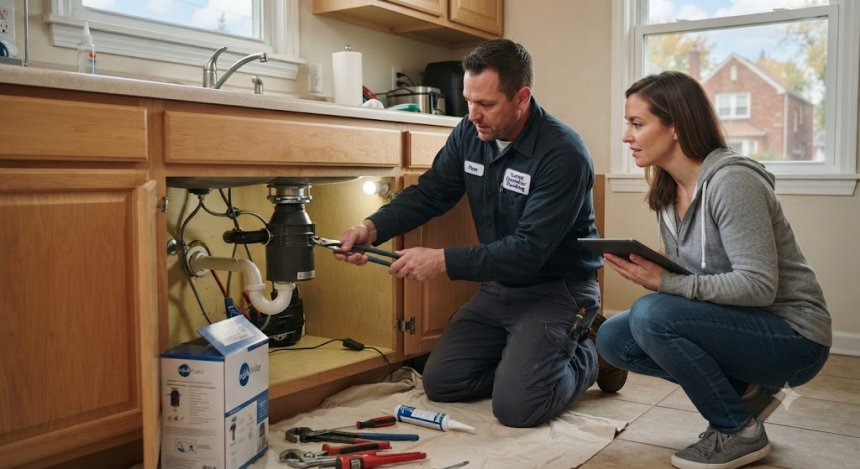
Precision Code-Compliant Installation: The new unit is mounted with a fresh gasket, the dishwasher knockout plug is removed (if applicable), and all PVC drain connections are aligned precisely.
-
Flow Verification & Clean-Up: Water is run to test for leaks under pressure, the motor is tested for balance and quiet operation, and the work area is left spotless.
DIY Reality Check: What You Can Safely Fix vs. When to Step Back
While swapping a lightbulb is simple, plumbing and electrical work under a kitchen sink present unique hazards. Knowing your limits protects both your home and your safety.
-
Safe Homeowner Actions: Pressing the red reset button on the bottom of the unit, clearing visible obstructions with tongs (never fingers!), and using an Allen wrench to manually turn the flywheel from below.
-
The Danger Zone: Working with live 120V electrical connections under damp sink conditions, modifying cast iron drain stacks without proper cutting tools, or attempting to support a heavy 3/4 horsepower unit alone while tightening mounting rings.
-
When to Call a Pro: If your unit hums but trips the circuit breaker instantly, if the mounting flange is rusted through the sink basin, or if you need hardwired electrical connections run to a new location.
Financial Breakdown: Cost Factors & Investment Realities
Investing in a new garbage disposal involves more than just the price tag of the appliance box from the hardware store. Professional installation pricing is shaped by several key variables:
-
Unit Horsepower & Quality: Standard 1/3 HP models cost less but struggle with heavy workloads, whereas continuous-feed 3/4 or 1 HP heavy-duty units with stainless steel grinding components require a higher initial investment.
-
Accessibility & Configuration: Tight workspace constraints, deep farmhouse sinks, or custom cabinetry can increase labor time.
-
Electrical Upgrades: If your kitchen lacks an under-sink electrical outlet and requires a dedicated circuit run by a licensed electrician, total project costs will reflect that additional labor.
-
Plumbing Modifications: Adjusting old, misaligned P-traps or transitioning from galvanized pipe to modern PVC ensures long-term reliability but adds minor material costs.
Unique Expert Insights: Hard Truths Homeowners Learn Too Late
Over years of hands-on fieldwork, master plumbers encounter recurring mistakes that could easily have been avoided with proper guidance:
-
Chemical Cleaners Cause Corrosion: Pouring harsh chemical drain openers into a jammed disposal ruins rubber gaskets and eats away at metal grind rings.
-
The Dishwasher Knockout Mistake: Forgetting to punch out the plastic plug inside the disposal dishwasher inlet causes dirty wash water to back up directly into the dishwasher tub.
-
Handyman Shortcuts Violate Code: Unlicensed handymen often bypass proper P-trap height requirements or electrical grounding rules, leading to failed home inspection reports during real estate sales.
-
Warranties Require Professional Install: Many premium disposal manufacturers void their parts warranties if the unit is not installed in strict accordance with local plumbing codes.
Comprehensive Home Plumbing Maintenance Framework
Protecting your kitchen sink and disposal system requires consistent habits spread across the changing seasons:
-
Spring & Summer Maintenance:
-
Flush the disposal with ice cubes and cold water to sharpen impellers and knock away organic buildup.
-
Inspect under-sink supply lines and shut-off valves for any signs of weeping or mineral deposits.
-
-
Fall & Winter Preparation:
-
Run cold water for at least 15 seconds after turning off the disposal to ensure all debris clears the main drain stack before freezing temperatures set in.
-
Avoid putting fibrous holiday cooking scraps (onion skins, turkey fat, potato peels) down the drain.
-
-
Year-Round Habits:
-
Never pour grease, cooking oil, or coffee grounds down the disposal; wipe pans with a paper towel first.
-
Periodically freshen the grind chamber by running citrus peels (lemon or orange halves) through the unit.
-
Emergency Protocol: When Immediate Dispatch is Non-Negotiable
While a jammed disposal is an inconvenience, certain kitchen plumbing scenarios require immediate emergency intervention:
-
Active Structural Flooding: Water spraying continuously from a cracked disposal body or compromised supply line that cannot be halted with the local shut-off valve.
-
Main Sewer Line Backups: Blackwater or raw sewage backing up through your kitchen sink basin and floor drains.
-
Electrical Hazards: Smoke, sparks, or burning plastic odors originating from the disposal motor or under-sink wall switch.
Frequently Asked Questions (FAQs)
Can I install a garbage disposal myself?
If you are replacing an exact model with identical wiring and mounting brackets, a handy homeowner can often complete the task in an hour. However, if new electrical wiring, pipe reconfiguration, or custom sink modifications are required, hiring a professional ensures code compliance and prevents leaks.
Why does my garbage disposal hum but not spin?
A humming sound typically means the flywheel is jammed by a foreign object (like a coin or bone) or seized by rust. Turn off the power immediately, use an Allen wrench in the bottom socket to manually rotate the motor, and remove the obstruction from above with tongs.
What foods should I never put down a garbage disposal?
Avoid fibrous vegetables (celery, corn husks, onion skins), expanding starches (pasta, rice, potato peels), coffee grounds, eggshells, and large amounts of grease or cooking oil, as these materials cause severe clogs and motor burnout.
How many horsepower do I need for a family home?
For a standard household of 3 to 4 people, a 1/2 or 3/4 horsepower continuous-feed disposal provides the ideal balance of power, speed, and reliability for daily meal preparation.
Do I need a permit to replace a garbage disposal in Detroit?
Simple like-for-like appliance replacements generally do not require a plumbing permit. However, if new electrical circuits are run or drain lines are structurally altered behind the wall, local Detroit building codes may apply.
How long does a typical garbage disposal last?
A quality garbage disposal typically lasts between 8 to 12 years, depending heavily on water quality, frequency of use, and how carefully homeowners avoid putting inappropriate waste down the drain.
Why is my new disposal leaking from the bottom?
A leak from the bottom housing usually indicates that the internal seals have failed due to age or internal damage. In this scenario, the entire unit must be replaced rather than repaired.
Can I connect my dishwasher to any garbage disposal?
Yes, most standard disposals feature a dedicated dishwasher inlet port. However, you must remember to knock out the internal plastic plug inside that port before attaching the dishwasher drain hose.