Why Upper Floors Lose Water Pressure in Detroit Homes
Discover why upper floors in Detroit homes experience low water pressure and learn what causes it, from scaling to municipal supply limits.


NEED A PLUMBER?
Fast & Local Plumbing Services
Leaks • Clogged Drains • Burst Pipes • Water Heaters • Emergency Plumbing
NEED A PLUMBER?
Fast & Local Plumbing Services
Leaks • Clogged Drains • Burst Pipes • Water Heaters • Emergency Plumbing
Understanding Upper-Floor Water Pressure Issues in Detroit
Dealing with a weak trickle in a second-story shower or struggling to get a steady flow from a bathroom sink on the top floor is a common frustration for property owners. Gravity naturally works against your plumbing system, meaning water has to fight uphill to reach higher elevations. However, when upper-floor pressure drops suddenly or remains persistently low, it usually points to a specific underlying issue within your home's infrastructure or the local municipal supply.
As a plumber working across Detroit, Michigan, I frequently troubleshoot upper-story flow complaints in everything from historic brick colonials in the neighborhoods to modern multi-story builds. Let's look at the primary reasons why your upper floors might be suffering from low water pressure and what you can do about it.
Gravity and Elevation Dynamics
The physics of plumbing play a major role in how water travels through your house. Every foot of vertical rise creates resistance and reduces water pressure. Generally, you lose about 0.43 pounds per square inch (PSI) of pressure for every foot water travels upward. If your incoming municipal water pressure is already on the lower end, the upper levels of your home will feel the impact first. In multi-story Detroit residences, a baseline incoming pressure that works fine in the basement kitchen might be entirely inadequate for a second- or third-story bathroom.
Common Culprits Behind Upper-Floor Pressure Drops
When upper-floor water pressure worsens over time rather than all at once, the issue is typically related to restrictions within your pipes or fixtures. Here are the most frequent causes:
Mineral Buildup and Scaling
Water chemistry varies, and older galvanized steel pipes—frequently found in historic Detroit homes—are notorious for internal mineral accumulation. Over decades, calcium and magnesium deposits narrow the interior diameter of the pipes. Because water takes the path of least resistance, restricted pipes starve upper-level fixtures of adequate volume and pressure.
Failing Pressure Reducing Valve (PRV)
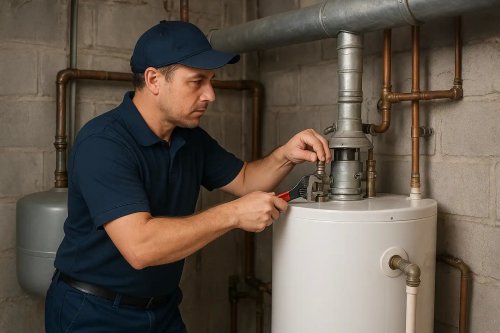
Many homes in the area feature a Pressure Reducing Valve located where the main water line enters the house. If this valve fails or gets clogged with debris, it can restrict the flow rate entering your home entirely. When a PRV goes bad, it often restricts pressure across the entire property, but the upper floors will notice the drop first due to elevation loss.
Partially Closed Shut-Off Valves
Sometimes the fix is remarkably simple. Check your main water shut-off valve, as well as any zone valves for upper-level plumbing. If a valve is not fully open, it will choke the flow rate. Even a valve that is turned just slightly out of alignment can significantly reduce water volume traveling to upper stories.
Troubleshooting and Next Steps
Before calling for professional Detroit plumbing services, you can perform a few basic checks around the house:
- Compare fixtures: Test the pressure on your main floor versus the top floor. If the basement and first floor have strong pressure while the second floor is weak, elevation and pipe restriction are likely the core issues.
- Check aerators: Unscrew the aerators on your upper-floor faucets. Mineral flakes and sediment frequently get trapped in these small screens, mimicking low water pressure.
- Inspect valves: Ensure all accessible shut-off valves are opened to their maximum capacity.
If these basic checks do not reveal a clear solution, or if you suspect your galvanized piping is heavily corroded on the inside, it is time to consult a licensed professional. A thorough pressure test at multiple fixtures will help determine whether the issue stems from your home's internal piping layout, a failing valve, or fluctuations in the local Detroit municipal supply.