How to Diagnose and Repair Low Water Pressure in Detroit Homes
Experiencing low water pressure in your Detroit home? Learn how to identify the causes, from mineral buildup to hidden leaks, and find out when to call a professional plumber.


NEED A PLUMBER?
Fast & Local Plumbing Services
Leaks • Clogged Drains • Burst Pipes • Water Heaters • Emergency Plumbing
NEED A PLUMBER?
Fast & Local Plumbing Services
Leaks • Clogged Drains • Burst Pipes • Water Heaters • Emergency Plumbing
Dealing with a weak stream of water when you turn on the shower or kitchen sink can be deeply frustrating. Low water pressure is a common issue faced by property owners across Detroit, Michigan, turning everyday tasks like washing dishes or taking a comfortable shower into tedious chores. As a plumber with two decades of experience working on residential and commercial systems throughout the Motor City, I have seen how varying factors—from local municipal supply traits to aging interior piping—can impact water flow.
Finding a lasting solution requires systematic troubleshooting rather than guesswork. By understanding how to isolate the problem, you can determine whether the issue is a simple fix you can handle yourself or a more complex plumbing repair that requires professional intervention.
Determining the Scope of the Problem
The first step in diagnosing low water pressure is figuring out whether the issue affects a single fixture or your entire house. Walk through your property and test multiple faucets, showers, and outdoor spigots.
- Single Fixture Issue: If only one faucet or showerhead has poor flow, the problem is almost always isolated to that specific hardware. Aerators, showerhead nozzles, or local supply shut-off valves are the usual suspects.
- Multiple Fixtures on One Floor: If a bathroom and kitchen on the same side of the house experience pressure drops, a branch line might be partially obstructed, or a shared shut-off valve could be partially closed.
- Whole-House Issue: If every tap in the house suffers from weak pressure, the root cause lies near the main water supply line, the pressure regulator, or the municipal supply entering your Detroit property.
Common Causes of Low Water Pressure in Detroit Properties
Once you know the scope, you can investigate the potential culprits. Different symptoms point toward distinct structural or mechanical issues within your plumbing system.
1. Clogged or Corroded Aerators and Showerheads
Mineral sediment buildup is a frequent issue for plumbing fixtures. Over time, calcium and lime deposits accumulate inside faucet aerators and showerheads, physically blocking the exit paths for water. Fortunately, this is the easiest problem to resolve. Unscrewing the aerator tip and soaking it in a vinegar solution typically dissolves the buildup and restores full flow immediately.
2. Partially Closed or Faulty Shut-Off Valves
Sometimes the solution is hidden in plain sight. If plumbing work was recently performed, or if a valve was bumped accidentally in a basement or utility room, the main water shut-off valve or meter valve might not be fully open. Additionally, older gate valves can fail internally, where the internal mechanism detaches and blocks water passage even when the handle is turned to the open position.
3. Failing Pressure Reducing Valve (PRV)
Most homes in Detroit feature a Pressure Reducing Valve designed to protect internal plumbing from high municipal supply pressures. When a PRV fails—often due to worn-out springs or internal diaphragm fatigue—it tends to restrict water flow entirely or drop pressure significantly throughout the entire home. Adjusting the bolt on top of the PRV may offer temporary relief, but a failing valve generally requires complete replacement.
4. Aging or Corroded Galvanized Piping
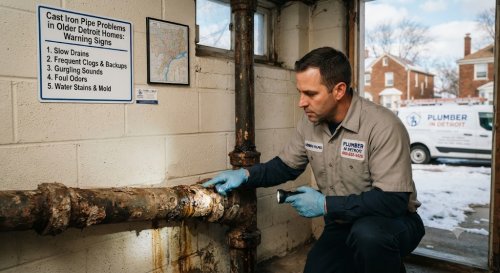
Many older homes throughout Detroit still contain legacy galvanized steel pipes. Over decades of service, mineral deposits and internal rust build up inside these pipes, progressively narrowing the inner diameter. This constriction starves your fixtures of adequate volume and pressure. If your home has galvanized piping and the pressure drops whenever multiple taps are opened simultaneously, pipe replacement is often the only permanent fix.
5. Undetected Water Leaks
A sudden, unexplained drop in water pressure can indicate a hidden leak somewhere in your system. When a pipe cracks behind a wall, under a concrete slab, or underground between the street and your foundation, water escapes before reaching your taps. You can check for hidden leaks by making sure no water is running anywhere in the house and observing your water meter dial to see if the leak indicator is moving.
Practical Diagnostic Steps for Property Owners
Before calling for professional Detroit plumbing services, you can perform a few safe, non-invasive checks:
- Check with your neighbors to see if they are experiencing similar pressure drops, which could indicate municipal infrastructure work or supply issues in your immediate Detroit neighborhood.
- Inspect all accessible shut-off valves around your water meter and water heater to ensure they are fully open.
- Remove and clean fixture aerators to eliminate local obstructions.
- Monitor your main water meter for movement when all indoor and outdoor faucets are turned off.
When to Call a Professional Plumber
While cleaning an aerator is a straightforward DIY task, whole-house pressure issues demand specialized tools and expertise. If your pressure regulator is failing, your main service line is compromised, or you suspect hidden pipe corrosion and leaks, attempting a DIY fix can lead to costly water damage. Experienced plumbers possess the pressure gauges, leak detection equipment, and pipe-threading tools necessary to diagnose and repair the root cause safely and efficiently.
Frequently Asked Questions
Why is my hot water pressure lower than my cold water pressure?
If only your hot water pressure is weak, the issue is typically isolated to your water heater or the hot water supply lines. Sediment buildup inside the water heater tank can clog the outlet pipe, or a faulty inlet valve on the heater may be restricting flow.
Could the city of Detroit be responsible for my low water pressure?
Yes, occasionally municipal water main repairs, hydrant flushing, or water department upgrades in your area can cause temporary pressure drops. Checking with neighbors helps determine if the issue extends beyond your property boundary.
Does a whole-house water filter cause low pressure?
It can. If your sediment filter or water softener cartridge becomes heavily clogged with debris, it restricts water flow into the home. Changing filtration cartridges on a regular maintenance schedule prevents this pressure drop.