How to Deal with Tree Roots Infiltrating Sewer Lines in Detroit Properties
Learn how to detect, clear, and prevent tree root infiltration in Detroit sewer lines. Expert advice for local homeowners facing blocked property drains.


NEED A PLUMBER?
Fast & Local Plumbing Services
Leaks • Clogged Drains • Burst Pipes • Water Heaters • Emergency Plumbing
NEED A PLUMBER?
Fast & Local Plumbing Services
Leaks • Clogged Drains • Burst Pipes • Water Heaters • Emergency Plumbing
Understanding Tree Root Intrusion in Detroit Sewer Lines
Tree root infiltration is one of the most common and destructive issues facing residential and commercial properties across Detroit. Older neighborhoods featuring mature canopies—such as the majestic maples, elms, and oaks found throughout many historic districts—often hide a subterranean struggle. As trees grow, their root systems constantly seek out reliable sources of moisture and nutrients. Underground sewer lines carrying warm wastewater present an irresistible target.
When tiny hair-like roots find even a microscopic crack, joint separation, or loose fitting in a lateral sewer pipe, they enter the interior. Once inside, the continuous supply of water and nutrients causes them to thrive, expanding rapidly and forming dense hairball-like masses. For property owners in Detroit, recognizing the early warning signs of root intrusion is essential before a minor blockage escalates into a complete structural failure of the drainage system.
Early Warning Signs of Root-Damaged Sewer Pipes
Before a sewer line completely collapses or backs up into your basement, the plumbing system usually exhibits distinct warning symptoms. Catching these indicators early can save property owners from costly emergency repairs.
Slow Drains Throughout the Property
If only one sink or tub drains slowly, the issue is typically localized to that specific fixture. However, when multiple plumbing fixtures—such as toilets, showers, and floor drains—begin draining sluggishly at the same time, the main sewer line is usually compromised. Tree roots inside the pipe create a physical barrier that restricts wastewater flow.
Gurgling Toilets and Floor Drains
Air pockets trapped behind root masses inside a sewer line have nowhere to escape except back up through your home's drainage fixtures. If you hear a distinct gurgling sound when flushing a toilet or running a washing machine, it often indicates a venting issue caused by a partial downstream blockage.
Frequent Sewer Backups
The most alarming symptom of root infiltration is wastewater backing up into basement floor drains or lower-level showers during heavy water use. Because Detroit experiences significant seasonal rainfall and rapid snowmelt, an already restricted sewer line overloaded with tree roots will quickly fail to handle the volume, resulting in messy basement backups.
How Plumbers Diagnose Root Intrusion
Professional diagnosis is critical to determining the exact extent and location of root damage within a sewer line. Experienced plumbers utilize specialized diagnostic tools rather than guessing the source of a blockage.
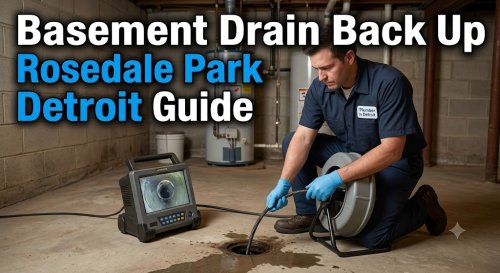
- Video Camera Inspections: A flexible, high-resolution waterproof camera is pushed through the cleanout directly into the main sewer line. This allows the plumber to view the interior walls of the pipe in real-time, locating exact root entry points, offset joints, cracks, or complete collapses.Locating Equipment: Once the camera pinpoints the problem area, a surface transmitter can track the exact depth and horizontal position of the damage in the yard, minimizing unnecessary digging on Detroit properties.
Effective Methods for Clearing Roots from Sewer Pipes
Depending on the severity of the intrusion and the structural condition of the pipe, several approaches are commonly used to restore proper flow.
Mechanical Root Cutting
For standard root blockages where the pipe structure remains intact, professional drain cleaning equipment utilizing specialized rotating cutting blades or hydro-jetting is deployed. High-pressure water jetting scours the interior pipe walls, completely stripping away root masses and grease buildup, leaving the line clear.
Trenchless Repair and Pipe Lining
If roots have repeatedly invaded a deteriorated clay tile or cast-iron sewer line common in older Detroit homes, cutting alone offers only a temporary fix. Trenchless pipe lining (Cured-In-Place Pipe) allows plumbers to insert a resin-coated liner through existing access points, inflating it to form a seamless, root-proof new pipe inside the old one without excavating the entire yard or driveway.
Preventative Strategies for Detroit Property Owners
While you cannot stop trees from growing, you can take proactive steps to protect your underground plumbing infrastructure.
- Strategic Landscaping: Avoid planting large, thirsty trees with aggressive root systems—such as willows, poplars, and maples—near your home's lateral sewer line. Keep new plantings at a safe distance from known utility paths.Root Barriers: Installing physical or chemical root barriers in the soil between large trees and your sewer line can divert root growth away from the pipe trench.Routine Maintenance: If your property has a history of mature trees near the sewer lateral, schedule routine camera inspections or preventative cleaning every 12 to 18 months to clear minor root intrusions before they cause a full blockage.
Frequently Asked Questions
Can chemical root killers completely solve a severe root problem?
Chemical foam root killers can retard root growth and kill roots inside the pipe, but they cannot remove dense blockages or repair physical cracks and structural breaks in the pipe wall. They work best as a supplementary maintenance step after professional mechanical cleaning.
Are older Detroit sewer lines more susceptible to tree roots?
Yes. Many older properties in Detroit feature clay tile, Orangeburg, or aging cast-iron sewer lines. These materials feature numerous joints or become brittle and crack over time, making it very easy for aggressive tree roots to penetrate.
Does homeowners insurance cover sewer line damage caused by tree roots?
Standard homeowners insurance policies typically do not cover damage caused by wear and tear, aging, or tree roots. However, some homeowners opt for specialized service line endorsements or utility line protection coverages that may assist with excavation and repair costs.
Can I clear tree roots from my main sewer line with a rented consumer drain snake?
Consumer drain snakes are generally designed for minor interior fixture clogs, such as hair in a bathtub drain. Attempting to clear a main sewer line packed with thick tree roots using undersized consumer equipment can result in the snake getting stuck or breaking off inside the pipe, complicating the repair process.